Land economics, housing markets, and development finance
Land economics
Buy land, they aren’t making it anymore
—Mark Twain
What makes land valuable?
- Most land is not very valuable
- Some valuable land is valuable because of intrinsic features of the land
- Natural resources
- Harbors
- Views
- But most valuable land is valuable because of what it is close to
What makes land valuable: urbanity
- The most valuable land is in urban areas, close to other things
- This determines the price of land, more than anything else
What makes land valuable: example 1
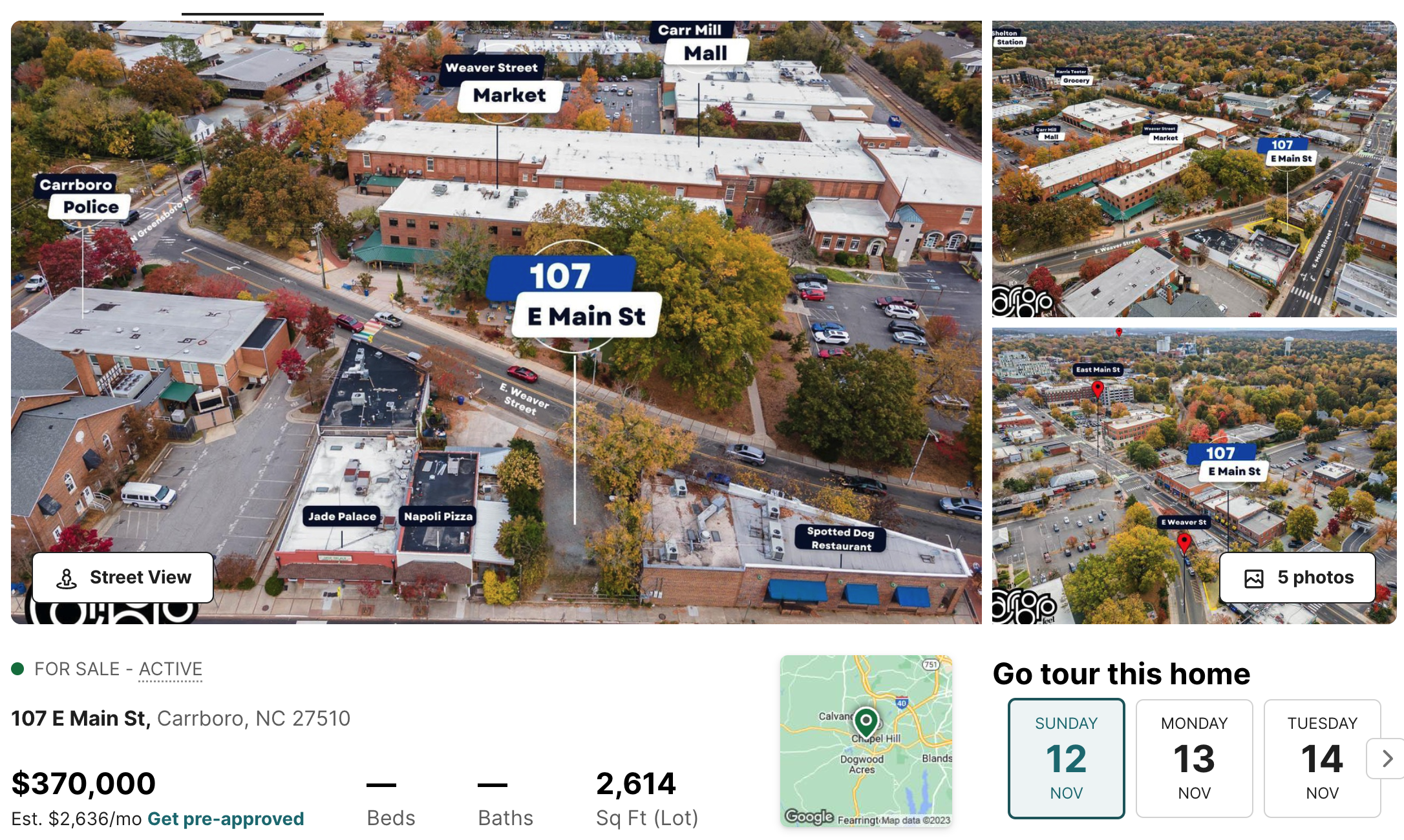
$370,000 for 2,600 square feet = $6.2m/acre
What makes land valuable: example 2
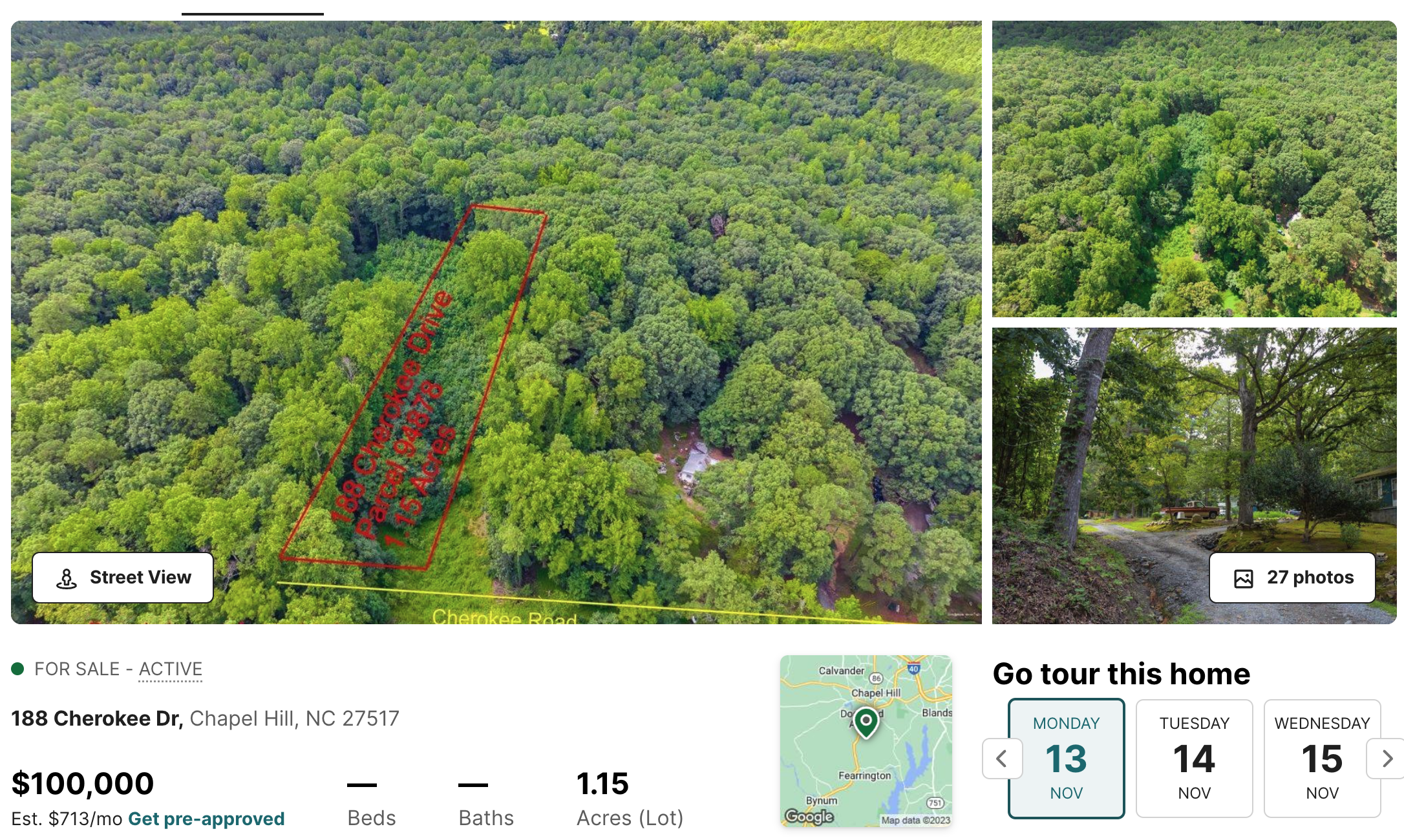
$100,000 for 1.15 acres = $87,000/acre
What makes land valuable: example 3
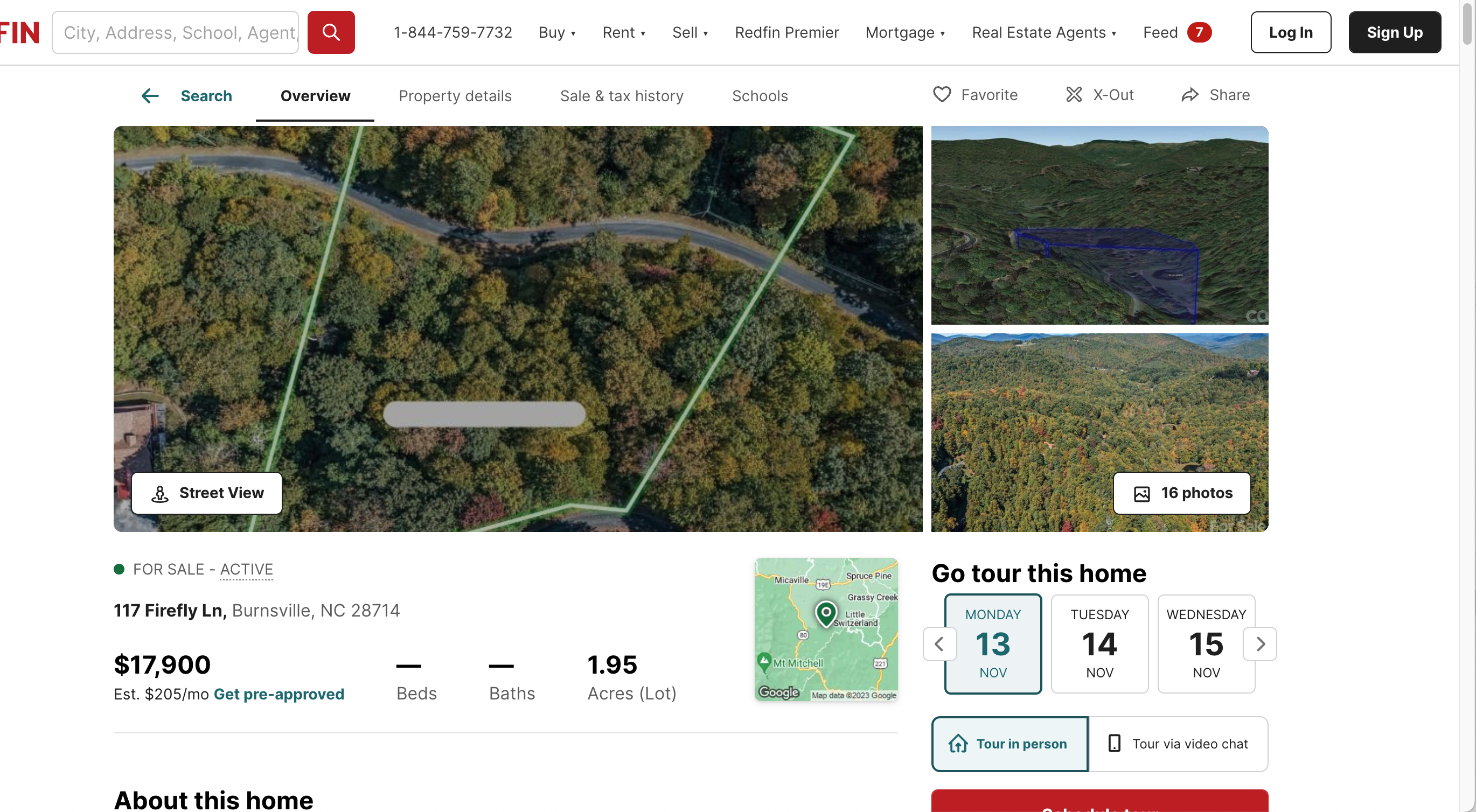
$17,900 for 1.95 acres = $9,200/acre
The monocentric city model
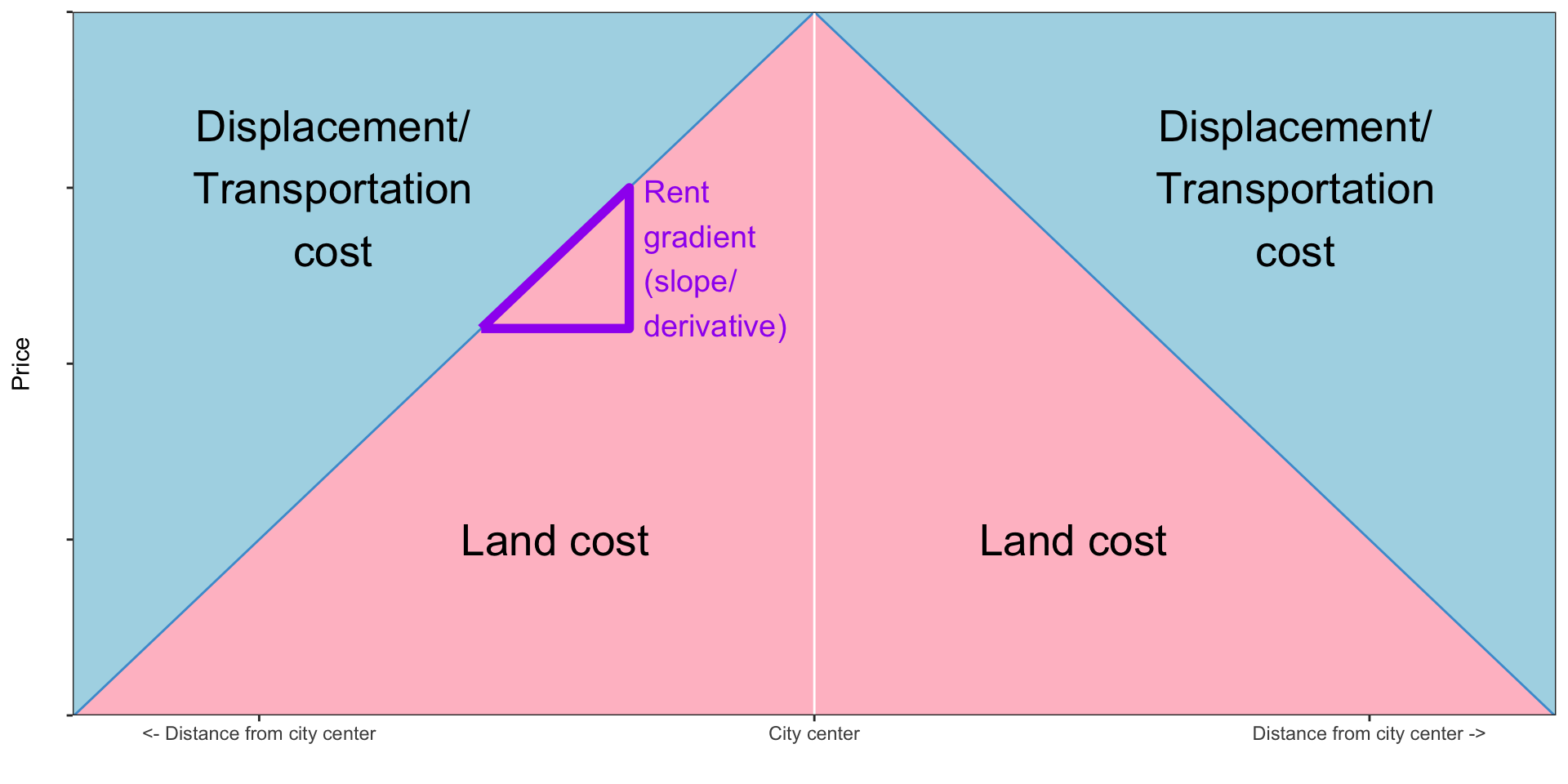
- The monocentric city model is a stylized model of land prices
- It considers a hypothetical city with a single city center where everyone works
- The city is laid out on a tabula rasa (Latin for blank slate)—no geographic/topographic features
- Also known as the bid-rent curve, Alonso model, or Alonso-Mills-Muth model
The monocentric city model: theory
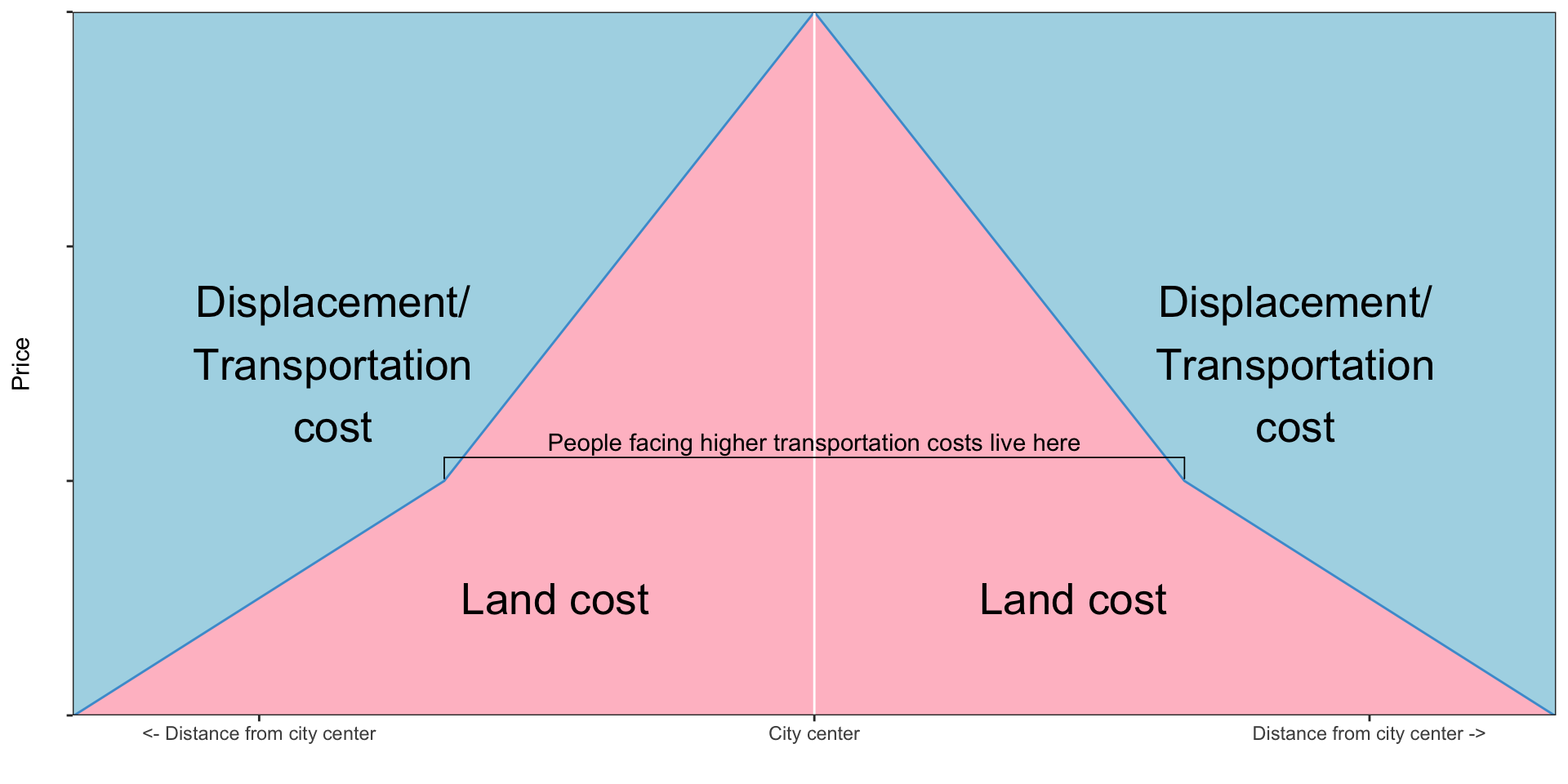
Differing transportation costs
- If different people face different transportation costs, the people with the highest transportation costs will choose to live at the center
- Transportation costs include time, too
- People with a high value of time will work harder to minimize transport costs than others
- We’ll return to the concept of value of time when we talk about transportation engineering
Differing transportation costs: theory
Differing transportation costs: food for thought
- Why do wealthy people often live in the suburbs in the US? 🤔
Land-intensive land uses
- Because land is so expensive at the center, land uses that require a lot of land are located in the suburbs
- They are better off paying higher transportation costs in the suburbs, because they require so much land
- This is why single family homes and warehouses are in the suburbs
- And why rich people often live in the suburbs
Substitution of capital for land
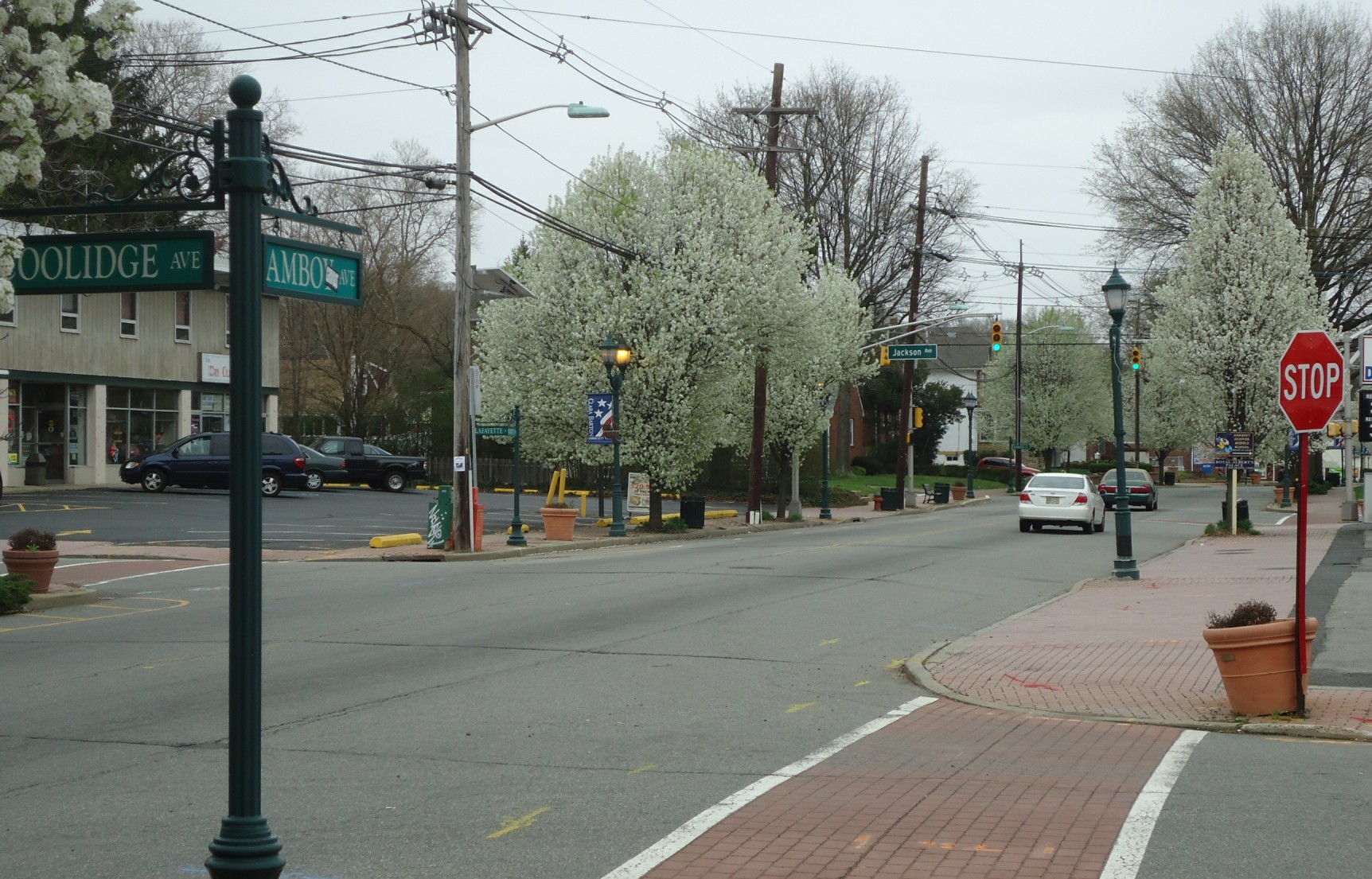
Why are there tall buildings in Manhattan, NYC, but not Edison, NJ?

Substitution of capital for land: theory
- The value of land is very high at the center of the city, but what people are (usually) buying is space
- We can increase the space per unit land by building up
- But building up is expensive, so it only happens in high-land-cost areas
- In lower cost areas, it’s cheaper to just buy more land
Notwithstanding this…
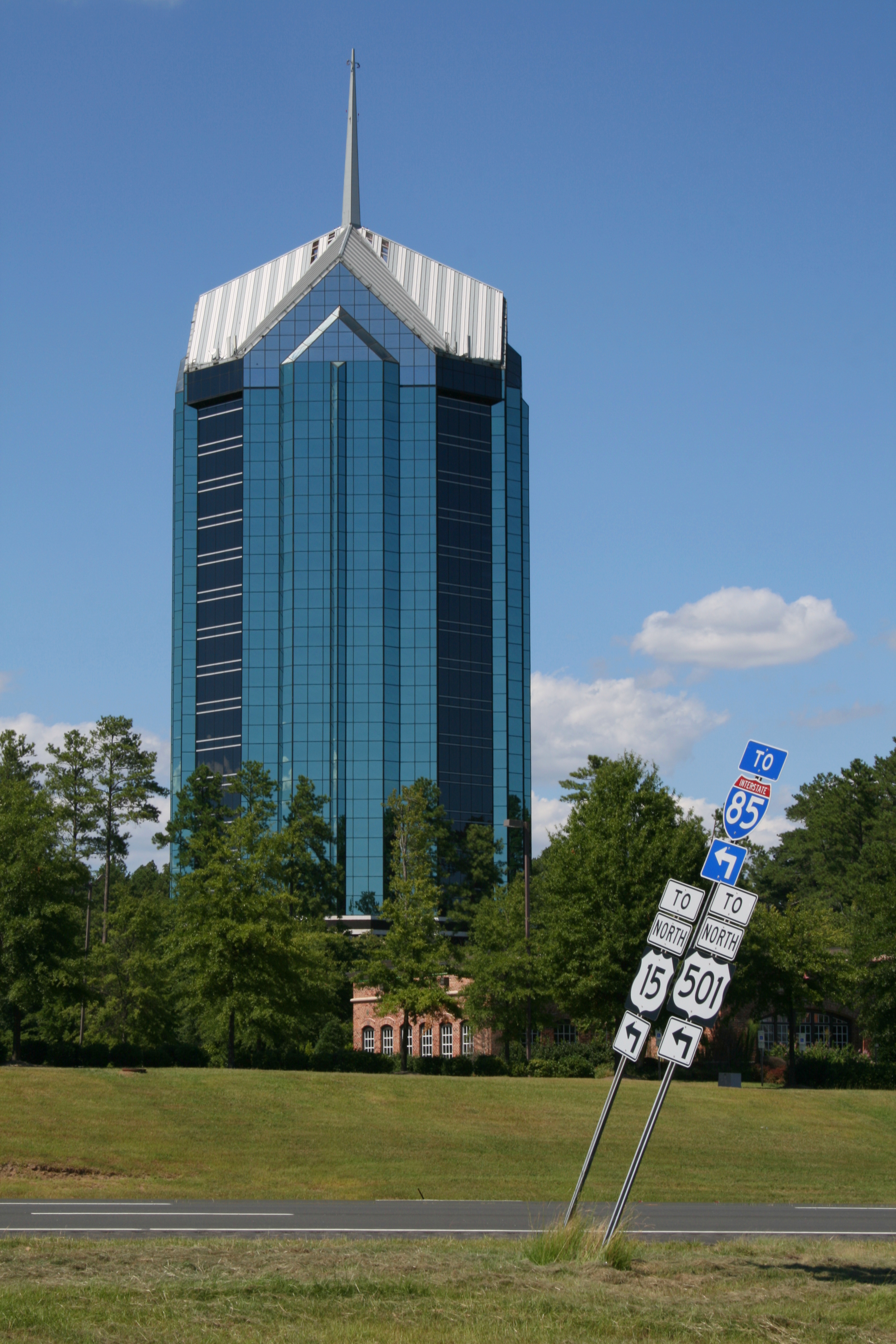
University Tower, Durham, NC, © Ildar Sagdejev
Density gradients
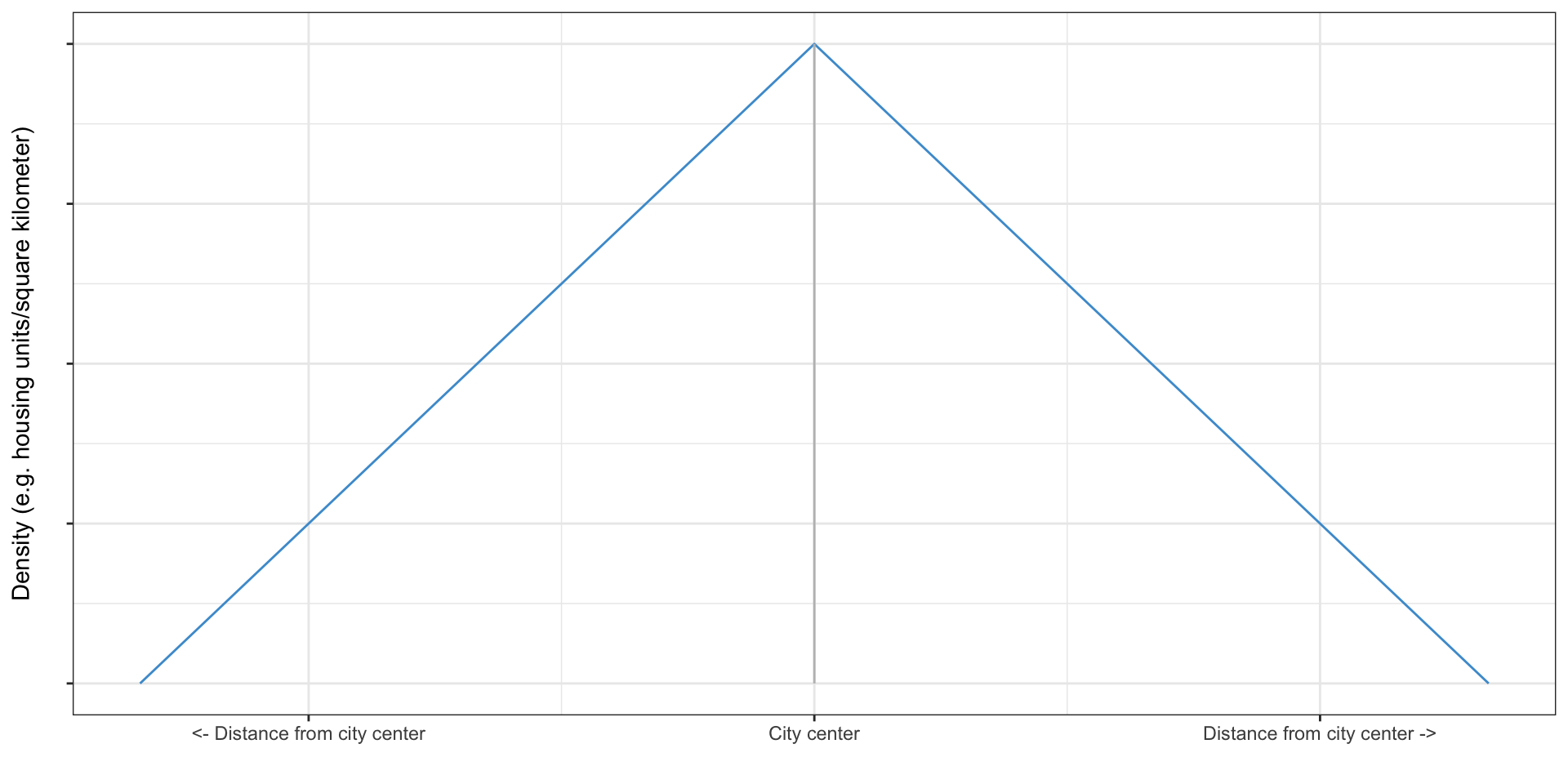
- The further you go from the city center, the less it makes sense to substitute capital for land, and the more low-density, low-value land uses you see (e.g. lawns)
- This is known as a density gradient
Density gradient, theoetically
Density gradient, in real life
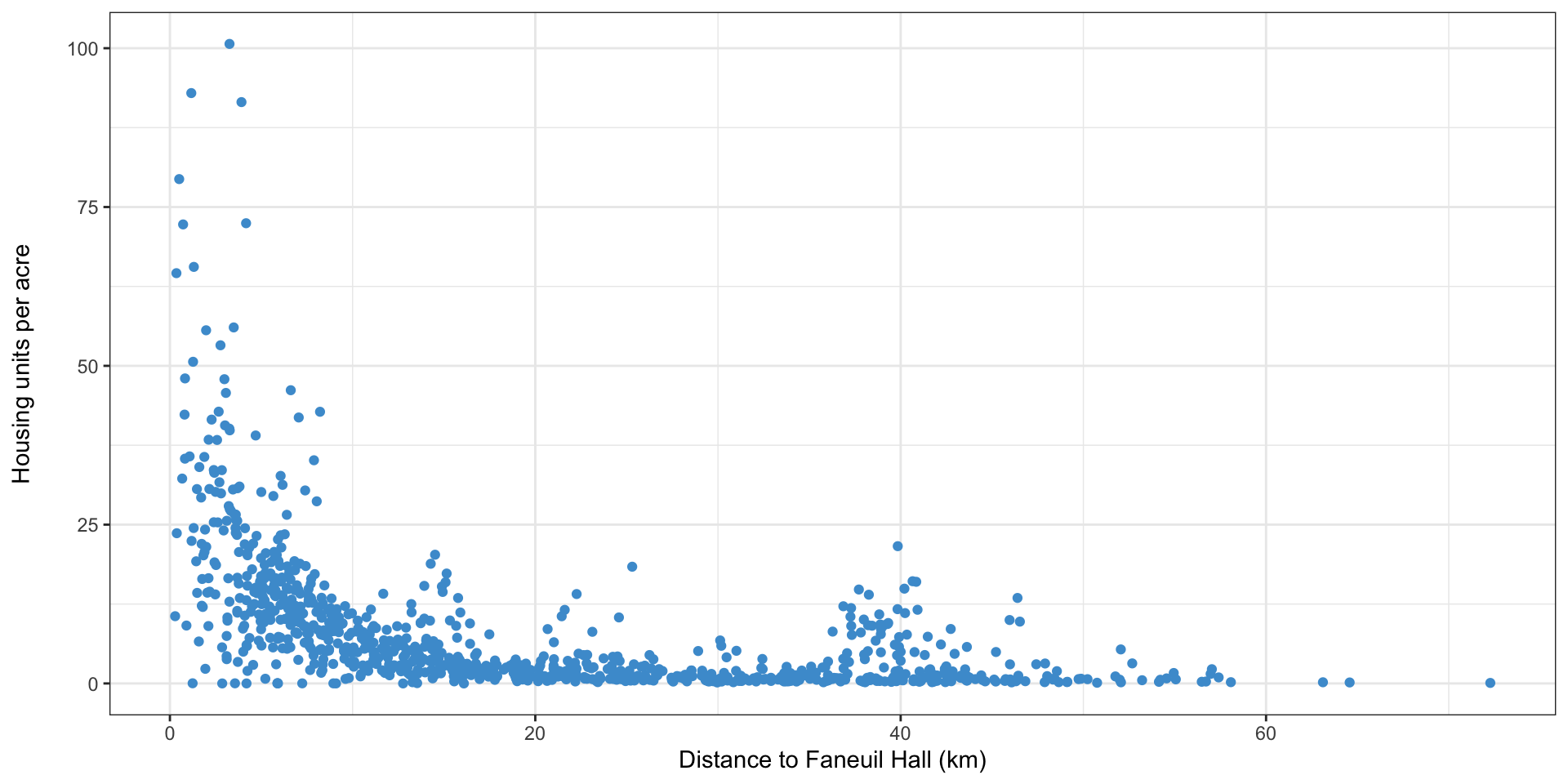
Density gradient, Greater Boston, MA (2020 decennial census)
Density gradient, in real life: exceptions
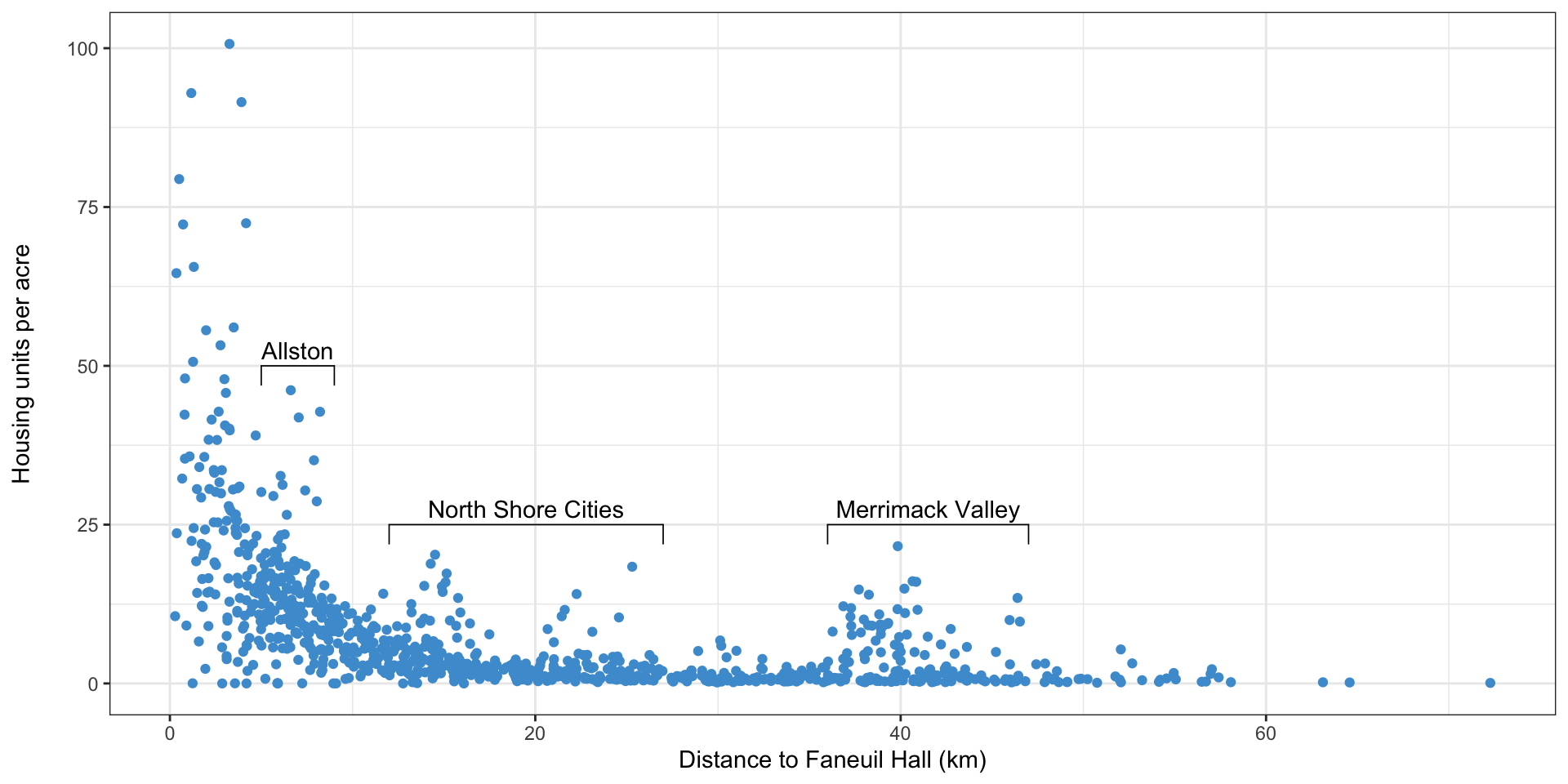
Density gradient, Greater Boston, MA (2020 decennial census)
Putting numbers on those prices
- The y axis of our bid-rent curve is labeled “price,” but there are no numbers
- The slope of the bid-rent curve is determined by transportation/displacement cost
- But how is the actual price determined?
- There are two very different ways, depending on assumptions about population change
The closed city model
- In a closed-city model, the population of the city is assumed to be fixed
- Rents at the edge of the city are fixed at zero
- Or agricultural rent
- The rent at the center of the city is determined by how much more than agricultural rents people will pay to live there
The open city model
- In an open-city model, the population can vary (people can enter or leave the city)
- Moving costs between cities are assumed to be 0 (the no-transaction-costs assumption)
- In this case, the rent at the center of the city is based on how awesome the city is
- Rents slowly fall away to zero
Which model is right?
- In the short run, the closed-city model closely matches reality
- In the long run, the open-city model more closely matches reality
- But both are simplifications
Assume a can opener
- All models are wrong, but some are useful
— George Box
The monocentric city model and zoning
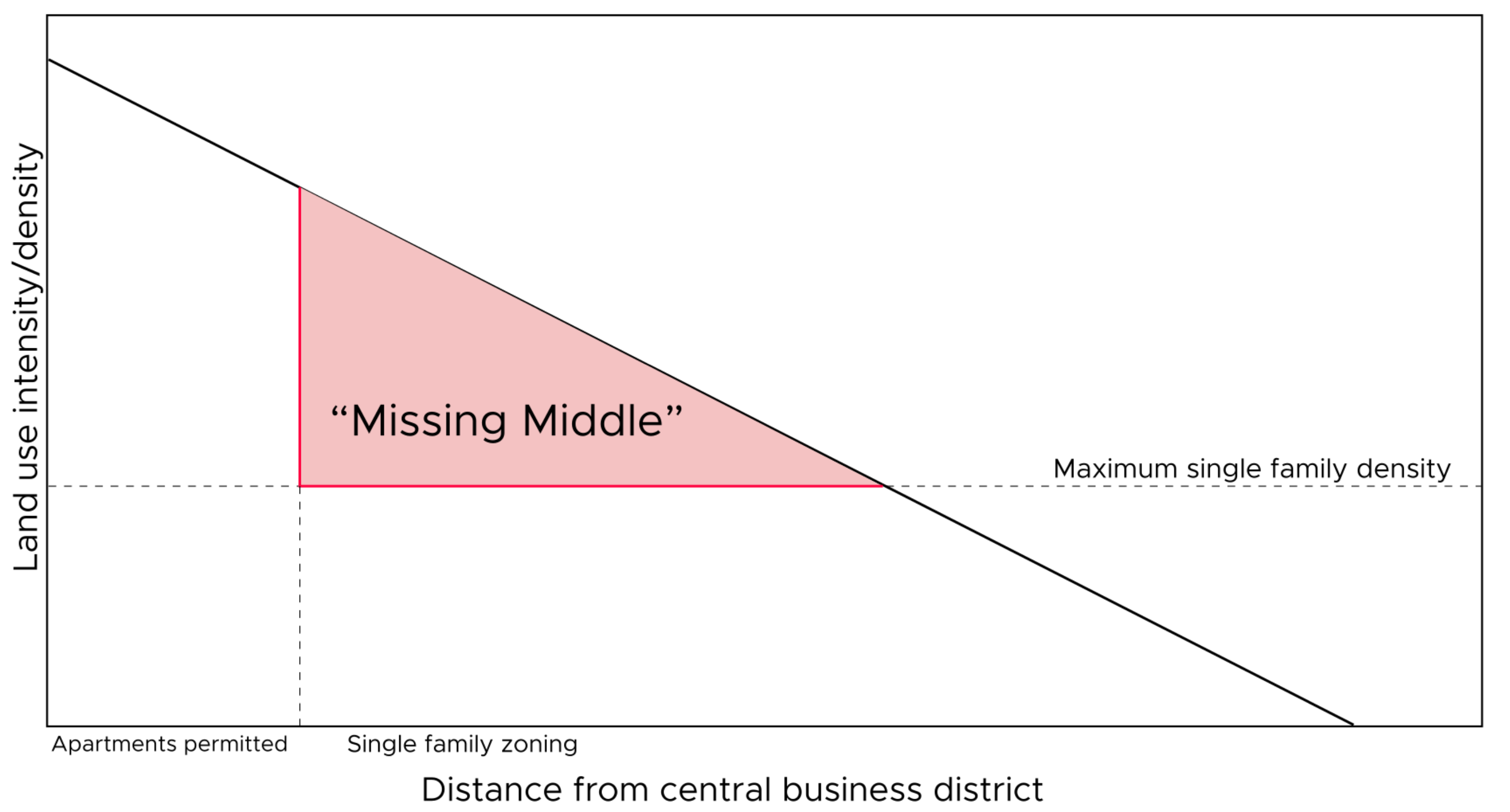
The monocentric city model and zoning: question
- What will happen if we zone for 20-story buildings in Hillsborough?
- Nothing (or lower-density development)
The monocentric city model and transportation
- How do we expect rents to differ between Manhattan and Jersey City?
- How would improved cross-Hudson access affect rents in the open vs. closed city model?
The monocentric city model and transportation: example
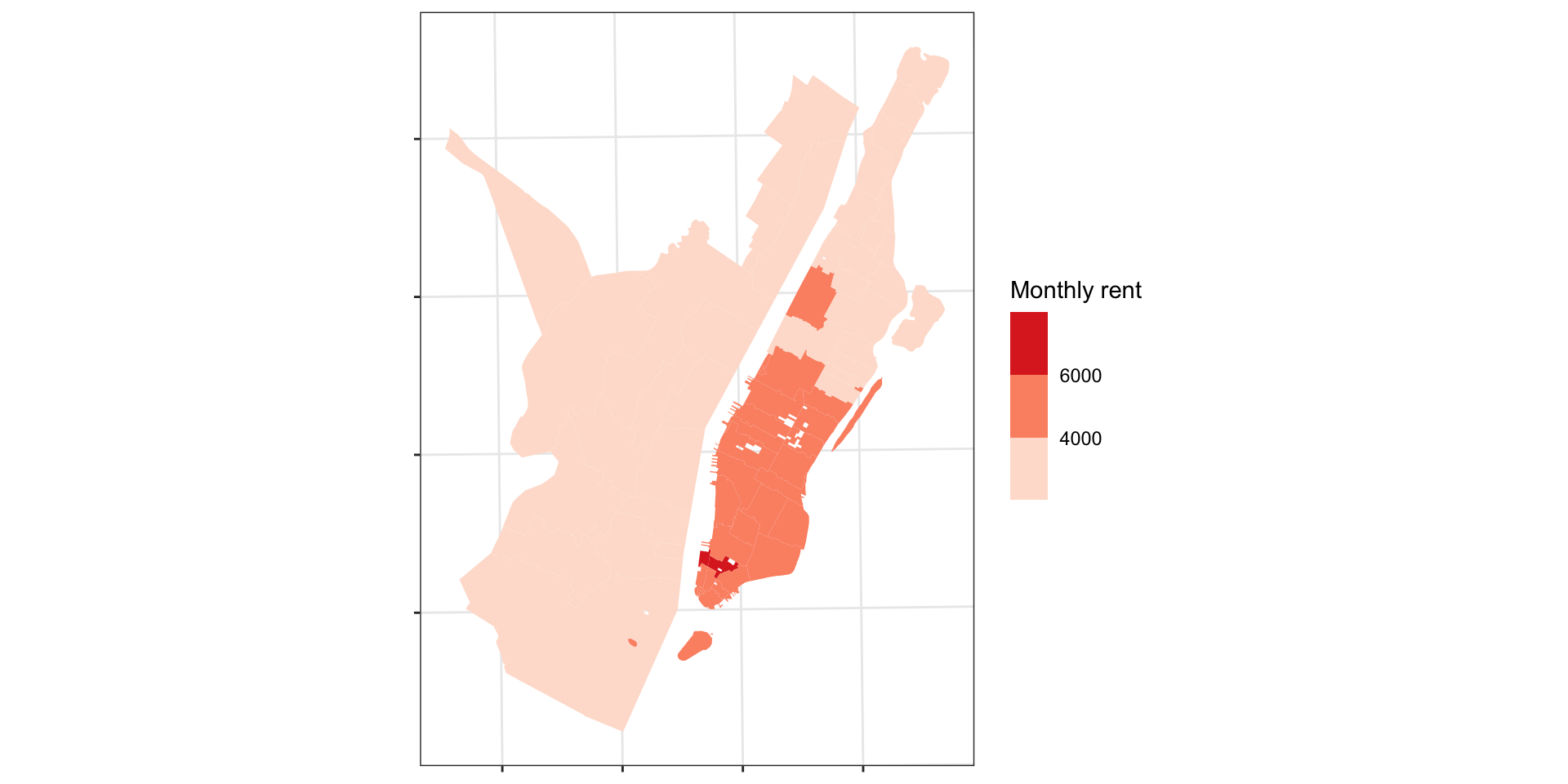
Monthly rent by ZIP code, Manhattan and Jersey City/Hoboken (Data: Zillow)
The time value of money
- Suppose I offer you $1 today, or $1.05 one year from today—which should you choose? Think about that for second without discussing with your neighbor
- $1.05 is more than $1, so why didn’t everyone take the $1.05?
- The fact that this wasn’t unanimous is because of the time value of money
The time value of money: theory
- The time value of money is simply that money (income or expenditures) in the future are worth less than money today
- The reason has to do with opportunity cost: if you had that $1 today, you could use it today for anything you want (including putting it in the stock market in hopes it will be worth more than $1.05 in one year)
- How much less money is worth a year in the future is the discount rate
Discount rates
- The discount rate will vary by project, and is a measure of both the time value of money/opportunity cost and the risk—a riskier (i.e. less sure to be profitable) project will have a higher discount rate
The time value of marshmallows
- Are kids who “fail” the marshmallow test (one marshmallow now or two in 15 minutes) really irrational, or do they just have a high marshmallow discount rate? 🤔
Discounted cash flow
The present value of money received \(x\) years in the future is
\[\frac{1}{(1 + r)^x}d\]
where \(r\) is is the discount rate and \(d\) is the amount to be received (Miles et al. 2015)
Why is this an exponential and not just a multiplication?
Each year we discount the already discounted values further
Discounted cash flow: risk
- Let’s return to the choice of $1 today or $1.05 in a year
- The current interest on a 1-year Treasury note is 3.7%
- This is considered the “risk-free” return rate—putting your money in a Treasury note (aka T-bill) is considered to be completely safe
- Though political brinksmanship may change this…
- There’s some risk that I won’t pay you $1.05 in a year—I might forget, go bankrupt, move to Australia, etc.
- So we need to increase this rate a bit to account for this—let’s raise it 2.5 percentage points to 6.2%
- Given this rate, what is the present value of $1.05 a year from now?
- \(\frac{1}{1.062^1}1.05 =\) \(.9887\)
- Who made the right choice?
Discounted cash flow: no risk
- What if I was completely trustworthy and there was no risk?
- The appropriate discount rate would be 3.7%
- \(\frac{1}{1.037^1}1.05 =\) \(1.0013\)
- Who made the right choice now?
- Thank you for trusting me :)
Discounted cash flow: over three years
- What if I offered you $1.50 three years from today, with the 6.2% discount rate? Should you take it over $1 today?
- \(\frac{1}{1.062^3}1.50\) = \(1.2523\)
Predatory lending
- All of this discussion supposes that you don’t need the money right now
- Or, more charitably, people who do need money right now can swap (a larger amount of) future money for the money they need now
- This is exactly what you’re doing when you take out a loan/mortgage, don’t pay your credit card bill in full, etc.
- Sometimes people do need the money right now, and this can lead to predatory lending—for instance, payday loans are often considered predatory
Discount rates from the consumer side: interest
- We usually think about discount rates on the supplier side
- But on the consumer side, interest rates are the same thing
- When you borrow money, the interest rate measures how much more you’ll have to pay back in the future
- This is because that future payment you will make is worth less than that amount of money now
- You’re basically swapping your future money for money today, and because of the time value of money you need to pay more in the future to make it worth it to the bank to swap for your money today
Loan terminology
- Principal: the actual money borrowed
- Interest: the money you pay to account for the time value of money
- APR: annual percentage rate, the annualized interest rate (e.g., for a loan paid monthly, this would be 12 times the monthly interest rate)
History of mortgages in the US
- Before the Depression, most mortgages had short terms and were interest-only
- That is, if you borrowed $5,000 to buy a home, you would pay only the interest on that for a few years, and the full $5,000 would be due at the end
- During and after the Depression, the Federal Housing Administration introduced the 30-year self-amortizing mortgage
- In a self-amortizing mortgage, you pay back some principal each month, in addition to interest
- As you pay more principal, there is less left, so you pay less interest
- At the end of your loan period, you have paid off all the principal
Mortgages in the news
- In 1999, Clarence Thomas borrowed $267,000 from a friend to buy an RV
- He got a five-year interest-only loan, which does not pay down the principal
- This is uncommon overall, and especially with vehicle loans, since the vehicle depreciates while the principal remains fixed
- Foreclosure several years down the road won’t pay back the principal
- The loan was eventually forgiven without the principal being repaid, because the lender felt the interest payments now exceeded the purchase price
- It’s not clear this was even true
- If anyone wants to call Chase and tell them about this, my mortgage could end in 2036 instead of 2052
Getting a mortgage/secured loan
- A secured loan is one where there is some collateral securing the mortgage—i.e. that the bank could reposses/foreclose if you don’t pay
- Vehicle and home loans the most common examples
- You make a down payment and then get a loan for the remainder
- Down payment percentages are ideally 20% but often much lower
- When lower than 20% you usually have to pay mortgage insurance
- This insures the bank, not you
Mortgage math: monthly payment
- The current rate on a 30-year fixed prime mortgage is ~6.2%
- Suppose we are buying a $450,000 home with a $50,000 down payment
- How much are we borrowing? $400,000
- How much is the monthly payment?
- The math is complicated, but we can do it in Excel
- The
PMTfunction calculates the payment - The
PPMTandIPMTfunctions calculate how much of each payment goes to principal and interest
Monthly payment: Excel syntax
- The syntax for the
PMTfunction is=PMT(rate, number of periods, present value) - The rate is your interest rate per period—mortgages are usually paid monthly, so our rate will be 6.6% per year / 12 = 0.517% per month
- Why not \(\sqrt[^{12}]{1.0517}\)?
- Because interest rates are generally reported as “simple” interest rates, 12 \(\times\) monthly interest rate
- The number of periods is the number of payments you will make (360 for a 30-year mortgage)
- The present value is what the loan is worth today—i.e., the loan amount
- What is the payment for our $400,000 loan?
=PMT(0.062 / 12, 360, 400000)= $2,450/month
Overall cost of a mortgage
- How much will we pay on our 30-year mortgage by the time we pay it off?
- \(2555 \times 360=\) $881,955
- What if interest rates went back down to what they were when I bought my house, 5.575%?
=PMT(0.05575 / 12, 360, 400000) * 360= [824,405]
Principal portion of payment
- How much principal are we paying in each payment?
- The
PPMTfunction will calculate this - The amount of principal in each payment is initially low, as you are paying interest on the full amount
- As you pay off the loan, each payment contributes more towards principal
- For the
PPMTfunction, the syntax is=PPMT(rate, period, number of periods, present value) - The same as the payment function, except you need to specify the period (1…number of periods)
- How much principal is being paid in the first period?
=PPMT(0.062 / 12, 1, 360, 400000)= $383- Calculate this for the rest of the periods
- Confirm that it totals $400,000
Interest portion of payment
- How much interest are we paying in each payment?
- The
IPMTfunction will calculate this - The amount of interest starts out high, as you’re paying interest on all of the principal
- As you pay off the loan, each payment has less interest as you owe less money
- For the
IPMTfunction, the syntax is=IPMT(rate, period, number of periods, present value) - How much interest is being paid in the first period?
=IPMT(0.062 / 12, 1, 360, 400000)= \(2,067\)- Calculate this for the rest of the periods
Amortization schedule
- What we’ve just created is an amortization schedule
Extra payments
- Most lenders let you make extra payments without penalty
- These contribute 100% to principal
- This effectively “fast-forwards” your loan to the point where the principal would be that low
- Your loan then ends earlier
- Let’s calculate how much we save by making a $10,000 extra payment after the first year (about 2.5 payments worth)
- Add a column with the remaining principal balance
- Either sum or use
=CUMPRINC(0.062 / 12, 360, 400000, 1, period, 0)
- Either sum or use
- How much does this save you?
- Should you do this? It depends on how your discount rate compares to the interest rate on your loan
Predatory lending and payday loans
- We talked about predatory lending earlier
- Payday loans are a common type
- According to the CFPB, typical costs are $15 per $100 borrowed
- If you pay $115 in two weeks to borrow $100 now, what is the annual interest rate?
- First, let’s calculate the interest rate for the two week period
- \(\frac{1}{(1 + r)^1}115 = 100\)
- Divide both sides by 115: \(\frac{1}{1 + r} = \frac{100}{115}\)
- Multiply by \(1 + r\): \(1 = (1 + r)\frac{100}{115}\)
- Divide by 100 / 115: \(\frac{115}{100} = 1 + r\)
- Subtract 1: \(1.15 - 1 = r\)
- \(r = 0.15 = 15\%\)
Payday loans: interest rate
- There are 26 two-week periods in a year
- What is the APR for this loan?
- 15% * 26 = 390% (!)
- Current APR for a cash advance from Discover is 26.49%
- Charging excessive interest is known as usury
Development finance
- In order for anything to get built, someone has to build it
- In almost all cases, that’s a private developer
- About 0.8% of housing units are publicly owned (Urban Institute and Census data)
- For a private developer to build anything, they have to make money doing it
How much money
- How much money they need to make is based on opportunity cost
- They need to make enough money building it that their return on investment is the same or better than anything else they could do with the money
- This needs to account for risk—building things is a lot riskier than investing in Treasury bills or even stock market index funds
Sources of money
- Debt financing: the developer borrows money, like we’ve seen above
- Equity financing: the developer or someone else contributes money in exchange for owning a share of the finished property
- At different points in the project, levels of risk differ, so interest rates differ
- Developers will generally layer multiple funding sources—loans, equity, possibly tax credits
How much is a project worth?
- What a project is worth is based on how much income it will generate
- Either through rentals or property sales
- The number usually used is the net operating income or NOI—the annual income minus expenses
Components of net operating income
- Potential gross rent: rent times number of units (+)
- Miscellaneous income—parking, cell towers, etc. (+)
- Maintenance (-)
- Management/administration (-)
- Capital improvements, sometimes—roof, HVAC, etc. (-)
- Property taxes (-)
- Nonpayment (-)
- Vacancy (-)
- Healthy rental housing vacancy rate is around 5% to avoid a game of musical chairs
Allston Christmas

70% of Boston leases begin on September 1 © Que165 on Reddit
Calculating net operating income
- Suppose as a class we’re considering buying that parking lot in Carrboro and putting a three-story, six-unit apartment building on it
- Let’s figure out if this “pencils out”
Calculating net operating income: the pro forma
- Current median(ish) rents in 27510 (central Carrboro) are $1,673/mo (Zillow Observed Rent Index)
- We’re building new housing, and we have a really excellent location; we can probably charge more
- Let’s assume that each unit will rent for $2,200/month
- What is our potential gross rent? \(\$2,200/mo \times 6 units = \$13,200/mo\)
- Let’s put this in Excel, so we can start to make a pro forma
- A pro forma is the document where developers calculate projected incomes and benefits
Calculating net operating costs: vacancy and nonpayment
- Let’s assume that we have a five percent vacancy rate, and 5% of remaining rent goes unpaid
- Let’s subtract five percent, twice
- Is this the same as subtracting 10%?
- Vacancy: \(-0.05 \times 13,200 = -660\)
- Unpaid rent: \(-0.05 \times (13,200 - 660) = -627\)
- Put these percentages in cells in Excel, and then refer to those cells to calculate vacancy and unpaid rent
Calculating net operating income: miscellaneous income
- Let’s assume we don’t have any of this (less common with smaller buildings)
Calculating net operating income: maintenance
- Things in houses break, and fixing them can be expensive
- Let’s assume 20% of potential gross rent goes to maintenance
- Add a cell with -0.2 * potential gross rent
Calculating net operating income: taxes
- We have to pay property taxes each year or we won’t get to keep our apartments
- Let’s assume property taxes are 20% of potential gross rent
- Add a cell with -0.2 * potential gross rent
Calculating net operating income: insurance
- We need insurance so if something happens to the building we don’t lose our investment
- Let’s assume insurance is 5% of potential gross rent
- Add a cell with -0.05 * potential gross rent
Calculating net operating income: management
- Let’s assume that management costs 10% of potential gross rent
- Add a cell with -0.1 * potential gross rent
Calculating net operating income: capital improvements
- Capital improvements are generally not a part of net operating income, but added separately when calculating total value
- Our building is brand new, so we shouldn’t need capital improvements for a while
- We’ll return to this in a moment
Net operating income: add it all up
- Sum up the rental income and all the expenses
- The net operating income is: $4,653 / mo
- What does this mean?
- This is income we expect to make each month on the six units
- Note that this does not include any interest (by design)
So how much is the building worth?
- $4,653 / mo
- But how does that translate to what the project is worth to an investor/on the market?
- We can add up the net operating income over time to figure this out
- What do we need to do to the net operating income in the future to understand how much the project is worth today?
- Discount it
- (also, apply inflation/appreciation factors)
Discounted cash flow analysis
- First, let’s annualize our net operating income: \(\$4,653 \times 12 = \$55,836\)
- We’ll assume we don’t get any money in the first two years, because we’ll be busy building the thing
- After that, we’ll sum up discounted cash flow for the next eight years
- And we’ll add in an estimate for sale value in year 10
Discounted cash flow analysis: rates
- We need to pick discount rates and appreciation/inflation rates
- Let’s assume inflation of 4% per year
- The current risk-free discount rate is 3.7%
- This project is probably pretty risky
- It’s in Carrboro, so we might face community opposition, required design or density changes, or slow approval processes—all of which cost us money
- Planning is not necessarily bad, but these things do have costs
- Let’s assume a discount rate of 8%
Discounted cash flow analysis: year 1
- For years 0 and 1, there’s no income, but we still pay property taxes
- They’re likely lower, though, since the lot is vacant
- Most governments tax both land and “improvements” (buildings), even though there’s a strong economic argument for taxing only land
- The current tax bill for the property is $3,600/year
- Taxes are reassessed every few years, so let’s not assume any inflation for taxes in the first two years
- Year 0: -3,600
- Year 1: \(\frac{1}{1.08} \times -3,600 = -3,333.33\)
Discounted cash flow analysis: year 2
- What is the discounted income in year 2?
- \(\frac{1}{1.08^2} \times 1.04^2 \times 55,836 = \$51,777\)
- Using Excel, repeat this process for years 3–9
- Use a formula and the
$syntax so you can just expand down
- Use a formula and the
- If you were expecting capital improvements, you would add them (discounted) to the appropriate year
The last year
- We generally assume we sell in year 10
- Estimation of the is sale price is more complicated
- We are going to assume that each year’s net operating income is 5.3% of the value of the property; this is called a cap rate
- So we divide the (inflated) year 10 net operating income by 0.053
- Let’s calculate this in Excel: $1,559,451.32
- We should subtract 9% for sale costs (realtor fees)
- And we discount this to year 10: $657,318
The present value
- We can now sum up the discounted cash flow to get what the building would be worth
- I get \(1,014,702\)
- This is the present value of the building—what it would be worth if it already existed
- What we want is the net present value—the present value minus whatever it will cost to build
Components of construction cost
- Land costs
- The construction cost itself—wood, concrete, nails, wire, and the labor to put it together
- Design and architectural costs
- Landscaping, hardscaping, drainage
- Demolition of existing structure (if necessary)
- Impact fees
- Contingency
Land cost
- Let’s assume we pay full price for the land–$370,000
- Add this to your Excel sheet in a new column
Construction cost
- There are estimating manuals available, which vary in complexity—some are as simple as a cost per square foot
- RSMeans is the best known provider of these
- We’ll use the International Code Council’s per-square-foot costs for Type III-A multifamily residential construction of $175.96/square foot
- Let’s assume each unit is 1,000 square feet, with no common areas, so 6,000 square feet total
- Add this to your Excel sheet
Other costs
- Let’s assume design and architectural costs are 10% of construction costs
- This is a small lot with minimal setback—let’s assume that we add a small landscaped plaza in front and behind, for $15,000
- There is no existing structure to demolish
- Carrboro/Orange County doesn’t charge impact fees after a 2017 showdown with the General Assembly
- We’ll add 10% of construction costs as contingency
Net present value
- Sum all that up—that is the total cost to build this building
- $1,651,912
- Subtract that from the present value: -$637,210
- For simplicity, we are assuming that all of these costs are incurred instantaneously, so don’t have to think about appreciation or discounting
- Does this mean the project will lose money?
- This is the net present value—basically, how much profit you expect to make above your required return based on the discount rate
- If it is positive, you should move forward
- If it is negative, the project is not profitable enough to justify its opportunity cost and risk
- Should we move forward with this project?
The pro forma
- The spreadsheet we’ve created is called a pro forma
- This is what developers use to make decisions about projects
- The one we made is simpler than one an actual developer would use, but the key components are all there
Net present value: higher rent
- The net present value is driven by a bunch of things, and since we’ve made our pro forma in Excel, we can easily adjust our assumptions
- $2,200 might be low for brand-new apartments in central Carrboro; let’s raise that to $3,000
- Maybe we can negotiate a lower price on the land—say, $320,000
- The net present value is still significantly negative (-215,706)
Net present value: lower discount rate
- Remember that our discount rate is based on the current interest rates, which are still relatively high (3.7% on a one-year Treasury)
- Shortly before the pandemic, the interest rate was 1.5% on a one-year Treasury
- Reduce the discount rate 2% to 6%
- Our net present value is now $20,719–the project now “pencils”
- Does this mean that building this building will only net $20,719 in profit?
Construction and permitting delays
- Some cities are known for long or uncertain permitting times, or requiring significant concessions from developers
- How would the net present value change if we had to wait three years instead of two before renting apartments?
- -55,800
- How would the net present value change if we could only build four units?
- -100,186
References

This work by Matthew Bhagat-Conway is licensed under a Creative Commons Attribution 4.0 International License.