Qualitative research
What is qualitative research?
- Most of what we’ve done so far has been quantitative - i.e. using numbers
- Research that does not use numbers (extensively)
- Often more exploratory and flexible than quantitative research
When to use a qualitative approach
- When you are trying to answer a qualitative question - i.e. not how much, how far, how different, etc.
- When you want to dig into causes and motivations
- When there is a poor existing understanding of a subject
- When you want topics to emerge organically
Grounded theory
- Most of the tools we’ve seen so far have been about testing theories with data
- e.g. a hypothesis tests whether the data we have observed is consistent with some theory
- Grounded theory is about the methods to empirically derive new theories
- Introduced by Glaser and Strauss (2017)
- Proposes theory be generated through comparative analysis, sequentially discovering
- categories and conceptual properties
- hypotheses and general relations
“Exampling”
- A danger with grounded theory is that the researcher engages in “exampling”
- That is, they have some idea how things work, and cherry-pick examples to demonstrate that
- Can be conscious or unconscious
Double-dipping
- In quantitative work, we are often concerned about double-dipping: using the same data to identify and test theories
- This is problematic because it can lead to a lack of replicability and generalizability
- The same is true of qualitative research
- This is why it is critical research is an ongoing endeavor
Coding
- Coding is arguably the most common way of organizing unstructured data
- You select excerpts from each document, and assign codes to them
- The codes are shared across documents
- This helps you understand which documents talk about similar things, and how prevalent different things are
This section heavily based on Saldaña (2021)
Coding: some terminology
- A document is a single piece of text (e.g. an interview, an article, etc.)
- A code is a descriptor linked to one or multiple pieces of text
Pre-coding
- Sometimes, it is helpful to highlight/italicize/underline during transcription or an initial read-through
- Can help get an initial idea of the body of work, and
- Make later coding more streamlined
Analytic memos
- These are notes that you write down about each document during coding
- Generally reflect your own summary of the document and anything important or surprising
- Very valuable for generalization
Coding methodology
- Keep in mind data-to-code ratio
- Try to re-use codes as much as possible
- A primary goal of coding is finding recurring patterns
Coding hierarchy
- Non-motorized
- Freight
- Highway/road
- Air
- Transit/rail
- Water
- Design
- Planning
- Policy/data analysis
- Theory
- Land use
- Multidisciplinary
Coding hierarchy
- Multimodal
- Non-motorized
- Freight
- Highway/road
- Air
- Transit/rail
- Water
- Skills
- Design
- Planning
- Policy/data analysis
- Theory
- Land use
- Multidisciplinary
Emergent vs. pre-defined codes
- With pre-defined or deductive codes, you come up with codes before reading the documents, possibly even before collecting the data
- Far more common emergent or inductive codes are created by the analyst during the coding process
- Not necessarily mutually exclusive
(Emergent) coding is not a linear process
- During the coding process, you will often revisit old codes to adjust, merge, or split them
- Even after coding, there is often a second stage of going through the codes to produce analytical insights
Codes to narrative themes
- Codes themselves are not the findings
- Codes are the basis of further analysis
- Codes and the original documents are then summarized into narrative “themes”
- e.g. a code might be “non-motorized” whereas a theme might be “Understanding the role non-motorized transportation plays in the urban transport system”
Brainspace for coding
- Valuable codes are going to depend on on your research questions
- It’s important to figure out those questions before coding, and keep those questions top of mind while coding
Types of coding
- There are many different types of coding
- We’ll cover a few here; more in Saldaña (2021)
- We’ll apply different types of coding to a few example documents
Example document 1
We like to think that we know things and we like people to give us clear numbers. So, tomorrow it’s going to rain. People have trouble with the idea that there’s a 40% probability of rain. People want to hear things like, ‘Well, 30 years from now, the temperature is going to go up by one degree Celsius or two degree Celsius or whatever, if we don’t do X, Y, and Z.’
But, we face a lot of uncertainty about the climate system, and I think we have to recognize the uncertainty. And, it doesn’t mean we shouldn’t do anything. It just means that we have to be clear about the things we understand and the things we don’t understand.
The simple fact is, we don’t know what will happen. Even if we knew how much CO2 will be emitted over the coming 50 years, we wouldn’t know how much the temperature would increase as a result and what will happen to sea levels. We might have estimates. But we don’t know.
And, even if we did know–even if we knew precisely what the temperature will do and sea levels will do over the next 50 years–we don’t know what the impact would be. We don’t know whether that would be devastating to world GDP [Gross Domestic Product], to the world economy; whether it would be a little bit harmful, whether it would be moderately harmful.
Macrocoding or “lumping”
We like to think that we know things and we like people to give us clear numbers. So, tomorrow it’s going to rain. People have trouble with the idea that there’s a 40% probability of rain. People want to hear things like, ‘Well, 30 years from now, the temperature is going to go up by one degree Celsius or two degree Celsius or whatever, if we don’t do X, Y, and Z.’
But, we face a lot of uncertainty about the climate system, and I think we have to recognize the uncertainty. And, it doesn’t mean we shouldn’t do anything. It just means that we have to be clear about the things we understand and the things we don’t understand.
The simple fact is, we don’t know what will happen. Even if we knew how much CO2 will be emitted over the coming 50 years, we wouldn’t know how much the temperature would increase as a result and what will happen to sea levels. We might have estimates. But we don’t know.
And, even if we did know–even if we knew precisely what the temperature will do and sea levels will do over the next 50 years–we don’t know what the impact would be. We don’t know whether that would be devastating to world GDP [Gross Domestic Product], to the world economy; whether it would be a little bit harmful, whether it would be moderately harmful.
- interpreting uncertainty
- climate uncertainty
- climate impacts
Microcoding or “splitting”
We like to think that we know things and we like people to give us clear numbers. So, tomorrow it’s going to rain. People have trouble with the idea that there’s a 40% probability of rain. People want to hear things like, ‘Well, 30 years from now, the temperature is going to go up by one degree Celsius or two degree Celsius or whatever, if we don’t do X, Y, and Z.’
But, we face a lot of uncertainty about the climate system, and I think we have to recognize the uncertainty. And, it doesn’t mean we shouldn’t do anything. It just means that we have to be clear about the things we understand and the things we don’t understand.
The simple fact is, we don’t know what will happen. Even if we knew how much CO2 will be emitted over the coming 50 years, we wouldn’t know how much the temperature would increase as a result and what will happen to sea levels. We might have estimates. But we don’t know.
And, even if we did know–even if we knew precisely what the temperature will do and sea levels will do over the next 50 years–we don’t know what the impact would be. We don’t know whether that would be devastating to world GDP [Gross Domestic Product], to the world economy; whether it would be a little bit harmful, whether it would be moderately harmful.
- Human interpretations of uncertainty
- Decisionmaking under climate uncertainty
- Future climate
- Impacts of climate change
Practical recommendations for coding
- If splitting (or even if not), number of codes can become overwhelming
- Regularly revisit emergent codes to combine
- Consider being selective about what you code
Coding paradigms
- Many different frameworks for developing codes
- The right choice will depend on the research question, the document type, and researcher preferences
- Coding paradigm may be chosen as part of the research design, or chosen based on experience reading the documents
Descriptive coding
- Codes are developed as simple descriptions of the topics discussed
- Often considered the “default” or obvious choice, but can lack depth and detail
- For example, the same code may apply to negative and positive emotions
- aka topic coding, index coding, topic tagging
Descriptive coding: example
We like to think that we know things and we like people to give us clear numbers. So, tomorrow it’s going to rain. People have trouble with the idea that there’s a 40% probability of rain. People want to hear things like, ‘Well, 30 years from now, the temperature is going to go up by one degree Celsius or two degree Celsius or whatever, if we don’t do X, Y, and Z.’
But, we face a lot of uncertainty about the climate system, and I think we have to recognize the uncertainty. And, it doesn’t mean we shouldn’t do anything. It just means that we have to be clear about the things we understand and the things we don’t understand.
The simple fact is, we don’t know what will happen. Even if we knew how much CO2 will be emitted over the coming 50 years, we wouldn’t know how much the temperature would increase as a result and what will happen to sea levels. We might have estimates. But we don’t know.
And, even if we did know–even if we knew precisely what the temperature will do and sea levels will do over the next 50 years–we don’t know what the impact would be. We don’t know whether that would be devastating to world GDP [Gross Domestic Product], to the world economy; whether it would be a little bit harmful, whether it would be moderately harmful.
- interpreting uncertainty
- climate uncertainty
- climate impacts
You don’t have to code every word
- To fit on the slides, I’ve heavily edited this example to just a few relevant pieces
- When working with actual text, you generally won’t assign a code to every word
- Some will be out of scope (e.g. interviewer questions, sometimes), or just not relevant to your research quesition
In vivo coding
- Codes are actual quotes from the text
- Less interpretation required
- Easier to preserve voice
- Generally leads to a large number of codes to be further summarized later
- There may be some opportunity for consolidation during coding
In vivo coding: example
We like to think that we know things and we like people to give us clear numbers. So, tomorrow it’s going to rain. People have trouble with the idea that there’s a 40% probability of rain. People want to hear things like, ‘Well, 30 years from now, the temperature is going to go up by one degree Celsius or two degree Celsius or whatever, if we don’t do X, Y, and Z.’
But, we face a lot of uncertainty about the climate system, and I think we have to recognize the uncertainty. And, it doesn’t mean we shouldn’t do anything. It just means that we have to be clear about the things we understand and the things we don’t understand.
The simple fact is, we don’t know what will happen. Even if we knew how much CO2 will be emitted over the coming 50 years, we wouldn’t know how much the temperature would increase as a result and what will happen to sea levels. We might have estimates. But we don’t know.
And, even if we did know–even if we knew precisely what the temperature will do and sea levels will do over the next 50 years–we don’t know what the impact would be. We don’t know whether that would be devastating to world GDP [Gross Domestic Product], to the world economy; whether it would be a little bit harmful, whether it would be moderately harmful.
- we like to think that we know things
- people have trouble with . . . probability
- uncertainty about the climate system
- it doesn’t mean we shouldn’t do anything
- we have to be clear about the things we understand
- we don’t know what the impact will be
Process/action coding
- Coding with verbs, specifically gerunds (-ing words) in each code
- Applicable in many cases
- Particularly useful for studies about human behavior
Process coding: example
We like to think that we know things and we like people to give us clear numbers. So, tomorrow it’s going to rain. People have trouble with the idea that there’s a 40% probability of rain. People want to hear things like, ‘Well, 30 years from now, the temperature is going to go up by one degree Celsius or two degree Celsius or whatever, if we don’t do X, Y, and Z.’
But, we face a lot of uncertainty about the climate system, and I think we have to recognize the uncertainty. And, it doesn’t mean we shouldn’t do anything. It just means that we have to be clear about the things we understand and the things we don’t understand.
The simple fact is, we don’t know what will happen. Even if we knew how much CO2 will be emitted over the coming 50 years, we wouldn’t know how much the temperature would increase as a result and what will happen to sea levels. We might have estimates. But we don’t know.
And, even if we did know–even if we knew precisely what the temperature will do and sea levels will do over the next 50 years–we don’t know what the impact would be. We don’t know whether that would be devastating to world GDP [Gross Domestic Product], to the world economy; whether it would be a little bit harmful, whether it would be moderately harmful.
- Thinking about uncertainty
- Recognizing uncertainty
- Planning for uncertainty
- Predicting the future
Versus coding
- Each code compares/contrasts two viewpoints or topics
Versus coding: example
We like to think that we know things and we like people to give us clear numbers. So, tomorrow it’s going to rain. People have trouble with the idea that there’s a 40% probability of rain. People want to hear things like, ‘Well, 30 years from now, the temperature is going to go up by one degree Celsius or two degree Celsius or whatever, if we don’t do X, Y, and Z.’
But, we face a lot of uncertainty about the climate system, and I think we have to recognize the uncertainty. And, it doesn’t mean we shouldn’t do anything. It just means that we have to be clear about the things we understand and the things we don’t understand.
The simple fact is, we don’t know what will happen. Even if we knew how much CO2 will be emitted over the coming 50 years, we wouldn’t know how much the temperature would increase as a result and what will happen to sea levels. We might have estimates. But we don’t know.
And, even if we did know–even if we knew precisely what the temperature will do and sea levels will do over the next 50 years–we don’t know what the impact would be. We don’t know whether that would be devastating to world GDP [Gross Domestic Product], to the world economy; whether it would be a little bit harmful, whether it would be moderately harmful.
- certainty vs uncertainty
- action vs inaction
- predictions vs impacts
Emotion coding
- Codes represent emotions experienced by participants
- Most appropriate for studies that are likely to have an emotional component
- e.g. interviews with planners about their work might be less appropriate
- or our example text
Example document 2
I had not expected, I think like most people, the storm to be much of anything. We figured eh, a couple inches in the basement, it’ll be a little annoying, and go to sleep. But in the middle of the night, that Friday night, the electricity went out a few times and I couldn’t breathe because I’m connected to a CPAP machine. I was like all, I didn’t think about it, but Saturday morning when I got woke up and I was like, thank you, Jesus, that I woke up, there was nothing, there was no electricity. And I was well shook. I was like, wait a minute, hold up. We got to find someplace for me to plug in.
Long story short, I basically did find that I could go to AB Tech, the medical shelter, right across from Mission Hospital because Mission was getting slammed. They were just getting slammed. And they were like, okay, AB Tech, can you take folks less critical. You know, if they just need to plug in or they just need checking on that sort of thing, just have ’em over here.
And it was very different. I was able to eventually plug in because they had generators at first and you didn’t have enough and they had to find some more and get some more coming in. And we had to wait for supplies. So the thing for me is that I had to come to an understanding for me personally that, well, I didn’t control nothing yesterday. I don’t control nothing today, and I don’t control nothing tomorrow.
Rev. Penny Meacham on her experience during Hurricane Helene, abbreviated
Emotion coding: example
I had not expected, I think like most people, the storm to be much of anything. We figured eh, a couple inches in the basement, it’ll be a little annoying, and go to sleep. But in the middle of the night, that Friday night, the electricity went out a few times and I couldn’t breathe because I’m connected to a CPAP machine. I was like all, I didn’t think about it, but Saturday morning when I got woke up and I was like, thank you, Jesus, that I woke up, there was nothing, there was no electricity. And I was well shook. I was like, wait a minute, hold up. We got to find someplace for me to plug in.
Long story short, I basically did find that I could go to AB Tech, the medical shelter, right across from Mission Hospital because Mission was getting slammed. They were just getting slammed. And they were like, okay, AB Tech, can you take folks less critical. You know, if they just need to plug in or they just need checking on that sort of thing, just have ’em over here.
And it was very different. I was able to eventually plug in because they had generators at first and you didn’t have enough and they had to find some more and get some more coming in. And we had to wait for supplies. So the thing for me is that I had to come to an understanding for me personally that, well, I didn’t control nothing yesterday. I don’t control nothing today, and I don’t control nothing tomorrow.
- lack of concern
- thankfulness
- fear
- urgency
- powerlessness
Values coding
- Assigning codes that represent values, beliefs, or worldview
- Best when intention is to extract viewpoints or understand culture
Values coding: example
I had not expected, I think like most people, the storm to be much of anything. We figured eh, a couple inches in the basement, it’ll be a little annoying, and go to sleep. But in the middle of the night, that Friday night, the electricity went out a few times and I couldn’t breathe because I’m connected to a CPAP machine. I was like all, I didn’t think about it, but Saturday morning when I got woke up and I was like, thank you, Jesus, that I woke up, there was nothing, there was no electricity. And I was well shook. I was like, wait a minute, hold up. We got to find someplace for me to plug in.
Long story short, I basically did find that I could go to AB Tech, the medical shelter, right across from Mission Hospital because Mission was getting slammed. They were just getting slammed. And they were like, okay, AB Tech, can you take folks less critical. You know, if they just need to plug in or they just need checking on that sort of thing, just have ’em over here.
And it was very different. I was able to eventually plug in because they had generators at first and you didn’t have enough and they had to find some more and get some more coming in. And we had to wait for supplies. So the thing for me is that I had to come to an understanding for me personally that, well, I didn’t control nothing yesterday. I don’t control nothing today, and I don’t control nothing tomorrow.
- higher power
- pragmatism
- lack of control
Magnitude coding
- Magnitude coding applies codes that have a value judgement (could be positive/negative or more nuanced)
- Often used when doing program evaluation, as it allows extracting sentiments towards the program
Example document 3
I was released from prison on July 7th, 2018. I went into sober living at Biltmore Housing, and I heard about this program, and I asked them about it. I had to get a referral through the re-entry program.
I had to work hard to get get where I’m at today. I had to prove that I was serious about it otherwise I wouldn’t have been eligible, and it took a couple months after I was referred for the program and paid for the car.
This car has totally changed my life. I was able to attend TransTech school and get my CDL [Commercial Driver License]. It starts at 6:00 in the morning, there’s no buses that early. After I got my CDL license it enabled me to get an awesome job. I’ve been a CDL driver for 16 months now with the same company. I love my job. I love the people I work with. But I have to be there 5:30. There’s no buses. I couldn’t do what I do without the car that I got from this program.
Public transportation in Asheville, they’re making strides, but it’s not nearly good enough. Many people work graveyard swing shifts, there’s no there’s no way to get home at night.
Kelly discussing her experience with Working Wheels, abridged
Magnitude coding: example
I was released from prison on July 7th, 2018. I went into sober living at Biltmore Housing, and I heard about this program, and I asked them about it. I had to get a referral through the re-entry program.
I had to work hard to get get where I’m at today. I had to prove that I was serious about it otherwise I wouldn’t have been eligible, and it took a couple months after I was referred for the program and paid for the car.
This car has totally changed my life. I was able to attend TransTech school and get my CDL [Commercial Driver License]. It starts at 6:00 in the morning, there’s no buses that early. After I got my CDL license it enabled me to get an awesome job. I’ve been a CDL driver for 16 months now with the same company. I love my job. I love the people I work with. But I have to be there 5:30. There’s no buses. I couldn’t do what I do without the car that I got from this program.
Public transportation in Asheville, they’re making strides, but it’s not nearly good enough. Many people work graveyard swing shifts, there’s no there’s no way to get home at night.
- ± application process”
- + life outcomes
- + economic outcomes
- - public transit
Multiple coders
- It is common to have multiple coders on a project
- Often, coders will double-code all or a subset of documents, to ensure consistency
- Even with a single coder, double-coding may be undertaken to ensure stability
Frontiers in coding: large language models
- Historically, coding has been done by humans
- Large language models are a promising tool for coding, with appropriate prompting
- Still very much an active frontier of research; I am working with a PhD student experimenting with this, and Dr. Palm has experimented with it as well
In vivo coding: my codes
We like to think that we know things and we like people to give us clear numbers. So, tomorrow it’s going to rain. People have trouble with the idea that there’s a 40% probability of rain. People want to hear things like, ‘Well, 30 years from now, the temperature is going to go up by one degree Celsius or two degree Celsius or whatever, if we don’t do X, Y, and Z.’
But, we face a lot of uncertainty about the climate system, and I think we have to recognize the uncertainty. And, it doesn’t mean we shouldn’t do anything. It just means that we have to be clear about the things we understand and the things we don’t understand.
The simple fact is, we don’t know what will happen. Even if we knew how much CO2 will be emitted over the coming 50 years, we wouldn’t know how much the temperature would increase as a result and what will happen to sea levels. We might have estimates. But we don’t know.
And, even if we did know–even if we knew precisely what the temperature will do and sea levels will do over the next 50 years–we don’t know what the impact would be. We don’t know whether that would be devastating to world GDP [Gross Domestic Product], to the world economy; whether it would be a little bit harmful, whether it would be moderately harmful.
- we like to think that we know things
- people have trouble with . . . probability
- uncertainty about the climate system
- it doesn’t mean we shouldn’t do anything
- we have to be clear about the things we understand
- we don’t know what the impact will be
In vivo coding: ChatGPT’s codes
We like to think that we know things and we like people to give us clear numbers. So, tomorrow it’s going to rain. People have trouble with the idea that there’s a 40% probability of rain. People want to hear things like, ‘Well, 30 years from now, the temperature is going to go up by one degree Celsius or two degree Celsius or whatever, if we don’t do X, Y, and Z.’
But, we face a lot of uncertainty about the climate system, and I think we have to recognize the uncertainty. And, it doesn’t mean we shouldn’t do anything.It just means that we have to be clear about the things we understand and the things we don’t understand.
The simple fact is, we don’t know what will happen. Even if we knew how much CO2 will be emitted over the coming 50 years, we wouldn’t know how much the temperature would increase as a result and what will happen to sea levels. We might have estimates. But we don’t know.
And, even if we did know–even if we knew precisely what the temperature will do and sea levels will do over the next 50 years–we don’t know what the impact would be. We don’t know whether that would be devastating to world GDP [Gross Domestic Product], to the world economy; whether it would be a little bit harmful, whether it would be moderately harmful.
- We like people to give us clear numbers
- We face a lot of uncertainty about the climate system
- it doesn’t mean we shouldn’t do anything
- Even if we did know…
ChatGPT prompt
- Can you code this text using in vivo coding?
- Can you use more of a “lumping” approach generating fewer codes? It’s okay if the codes are just quotes from the coded section rather than the full text, or even applied to other related sections.
- Can you attach those broader codes to the original text?
Audio
- Historically, coding almost always done with text data
- Some software now can apply codes directly to audio or video
- Tradeoff is getting into the coding process faster, but listening is slower than reading
Software for qualitative coding
- For very simple projects, coding with Word, Excel, or on paper may be sufficient
- For anything with more than a handful of short documents, purpose-built software should be used
- There are many software packages for qualitative data analysis
- Common ones include NVivo, Dedoose, Atlas.ti
Qualitative research and causality
- One criticism of (particularly emergent) coding is that the codes come from the same data used to test hypotheses
- Depending on the analyst’s viewpoints, they may be able to influence the codes to get the result they want
- This is very similar to \(p\)-hacking, but potentially even more problematic as there is more flexibility (Egami et al. 2022)
- but stay tuned…
Hypothesis coding
- Hypothesis coding is a type of pre-determined or deductive coding
- Codes are specified before coding, with the specific goal of measuring some hypothesis
- Based on theory, or previous study
- Ideally before data collection, or by someone minimally involved in data collection
- Hypotheses are made about how often the codes will occur, or how they will relate to one another
Causality and emergent coding: train/test coding
- What if you don’t have a theory or hypothesis beforehand?
- Egami et al. (2022) propose splitting the data into two parts
- one to use to code emergently/inductively
- one to use to test hypotheses generated from coding the first part
- This may be a 50/50 split or something else
- But of course requires more data collection
Causality with outcomes
- In randomized trials and causal inference, we measure some outcome, and are trying to use it to make some inference about an underlying causal process
- You can do this with qualitative work as well
- A fairly common example is exposing folks to different prompts/questions and seeing if their reactions differ
- In this situation, these concerns should be forefront
But wait! Causality with processes
- With qualitative research, we have another option: we can measure processes directly
- i.e. we can ask people why they did something, or how they would be affected by some change
- Then we are freed from the need to infer causes—we can measure them directly
- Won’t work with everything (e.g. subconscious behaviors), but a promising method for lots of things
- Unfortunately not always accepted by the scientific community, though this is improving
Sources of qualitative data
- Interviews
- Published documents
- Public meeting comments
- Social media
- Ethnography
Ethnography
- Ethnography is studying people in their communities, rather than through interviews or written documents
- The researcher may be an observer in the community,
- Or become embedded into the community as a participant
- Dr. Hernandez’s research is based in ethnography
Mixed methods research
- “Mixed methods” is research that uses multiple methods, generally a mixture of quantitative and qualitative research
- The methods complement in each other in different ways
Qualitative research before quantitative
- Qualitative research can generate hypotheses, ideas for survey questions, or motivate a research question
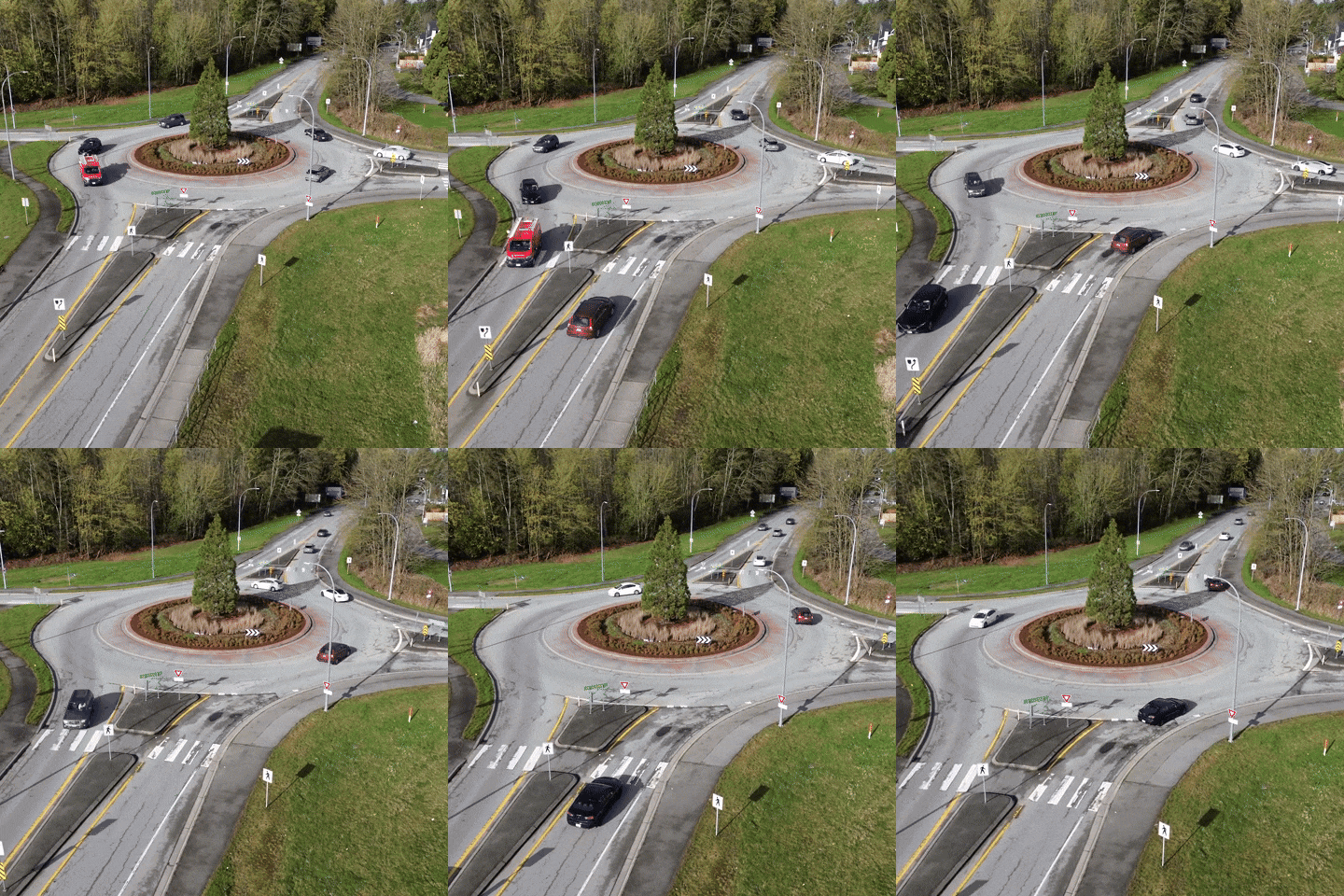
Roundabouts are for rich people
- In a recent project, Drs. Hernandez, Palm, Combs, and I looked into the distribution of roundabouts
- We motivated this work with qualitative interviews with community members requesting roundabouts in underserved communities
- There were concerns that roundabouts and their safety benefits were less available in lower-income neighborhoods
- We then proceeded to build a regression model of where roundabouts exist, to test and generalize the theory developed from the interviews
- (and ultimately confirm it)
Qualitative research after quantitative
- Qualitative research can help understand why observed patterns exist in quantitative data
- It can provide additional insights for subpopulations too small to support quantitative research
Residential location choice process
- My PhD advisor was really interested in how people choose where to live
- In grad school, we did a number of quantitative studies about this
- She then followed these up with interviews to get a better understanding of the processes we were documenting with our quantitative models
Quantitative methods for text
- There are a number of quantitative tools that can be used with textual data, blurring the lines between qualitative and quantitative work
Quantitative analysis of coded data
- It is very common to count and look at coöccurence of codes across documents
- While this can be useful, it is important to remember this is not the primary outcome of qualitative work
- Qualtitative work often doesn’t have the same types of sampling that allow us to quantitatively generalize
- nor should it, that is not the point
Other techniques
- Word clouds
- Sentiment analysis
- Topic modeling
References

This work by Matthew Bhagat-Conway is licensed under a Creative Commons Attribution 4.0 International License.